Time to wake up and get ready for a fight
Teachers and defenders of public education are raising their voices against a court decision in California that strikes down five laws protecting teacher tenure and seniority. The court case, Vergara v. State of California, represents another phase in the corporate school "reform" campaign to scapegoat teachers.
Los Angeles Superior Court Judge Rolf Treu bought the anti-teacher arguments put forward by the plaintiffs. While filed in the name of nine minority students, the case was stage-managed by Students Matter, an organization founded by Silicon Valley millionaire David Welch, which bankrolled a team of lawyers and corporate public relations campaign.
Treu explained his ruling to strike down workplace safeguards and due process rights for teachers with the claim that job protections kept "grossly ineffective teachers" in classrooms that disproportionately serve "low-income and minority students"--making them discriminatory. And the proof for this outrageous statement? Treu accepted the corporate reformers single-minded obsession with standardized test scores--essentially concluding that low test scores equals "grossly ineffective teachers."
But as teachers and public school advocates were quick to point out, research proves that the most important factors in test scores are poverty, class and racial discrimination. "Rather than provide resources or working to create positive environments for students and teachers, this suit asserts that taking away rights from teachers will somehow help students," said Joshua Pechthalt, president of the California Federation of Teachers, in a statement. "This suit...is fundamentally anti-public education, scapegoating teachers for problems originating in underfunding, poverty, and economic inequality."
The deform champions who pushed the Vergara case claim they are concerned about the quality of education for the most vulnerable children in society, especially African Americans and Latinos. But these same champions are directly responsible for the ruinous state of public education in inner cities. Like Education Secretary Arne Duncan, who hailed the Vergara decision--before joining Barack Obama's administration, he was notorious for shutting down schools and cutting budgets in the Chicago Public Schools.
"If they were truly interested in supporting the needs of the children," wrote education policy expert Diane Ravitch, "the backers of this case would be advocating for smaller classes, for arts programs, for well-equipped and up-to-date schools, for after-school programs, for health clinics, for librarians and counselors, and for inducements to attract and retain a stable corps of experienced teachers in the schools attended by Beatriz Vergara and her co-plaintiffs."
CFT officials say they anticipated a bad outcome from this judge and believe the decision will be overturned on appeal. But many teachers, in California and around the country, don't want to wait and hope. Here, a California teacher and union activist argues that the Vergara decision must be confronted head-on--with protest and public pressure to turn back the tide of attacks on teachers and public education.
IF I could get rank-and-file teachers into an auditorium to talk about the Vergara decision, this is the outline of what I would advocate:
1. Confront the corporate reform agenda. There are 400,000 teachers in a state of 38 million people. We don't need full-page newspaper ads or million-dollar television commercials to reach a wide audience. In fact, face-to-face organizing is precisely where the millionaires and billionaires pushing "reform" can never match us.
2. Time to get out the litmus paper and test the politicians. The Vergara decision is a defining moment in California politics. Obviously we need to sever ties with any politician who favors this blatant attack on teachers. But we also need to cut loose from all of the state and national leaders who have fueled the "blame teachers" narrative that underpins Vergara.
3. Get ready to rumble. After all, that's how we won job protections in the first place. In the 1970s, the California Teachers Association encouraged illegal strikes to force the legislature to recognize collective bargaining rights for educators. These strikes led to the landmark Educational Employment Relations Act of 1976, which is more favorable to workers than federal labor laws. And not a single teacher was dismissed for striking.
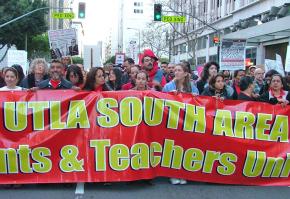
4. Repeat as necessary. California's teachers unions aren't likely to pursue this last strategy for two reasons: first, their attorneys believe they will win on appeal to a fairer judge; and second, the potential halving of our membership is still too far off for the graying leadership to see it affecting their own careers.
After more than three years of promoting its Facebook and Twitter accounts to members, the California Teachers Association has over 320,000 members and less than 15,000 followers on social media. That illustrates how atrophied the organization has become.
Despite our sorry state of preparedness, though, this isn't a time to despair. For every local that went on strike in the 1970s, there were a dozen that didn't. My point is that there's a lot of room for successful militancy between the situation we find ourselves in today and the high water mark of a statewide general strike, and we need to go about organizing in between.
Hopefully, the Vergara decision will be overturned on appeal. But if it isn't, somewhere, a very good teacher is going to be fired by a vindictive or bigoted school board. Then it will be up to that teacher's co-workers to take a powerful and courageous stand: "We won't come back to work until our colleague comes back, too."
The mighty oak tree grows from the tiny acorn.